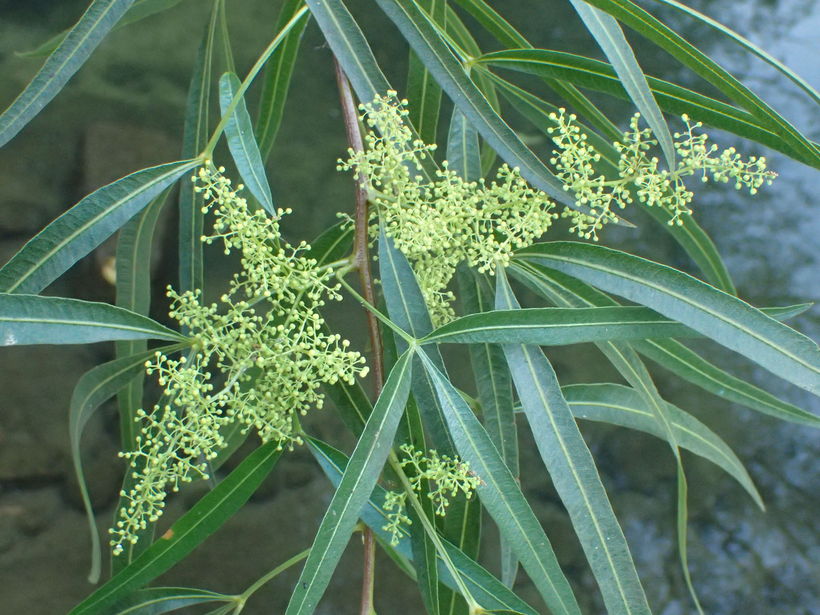
Climate Matching Map
| Attachment | Size |
|---|---|
| climatematch-searsia_lancea-nevada-20250205.pdf (1.05 MB) | 1.05 MB |
1. Question 1
Yes
1
Very High
Searsia lancea is native to Southern Africa from Zambia and has been noted to have become naturalized in other regions including some parts of the United States, New Zealand, and New South Wales (Weedwise, 2018). Larger populations have been documented around Tuscon, AZ and along the Southern California coast by the Jepson Herbarium and the University of Arizona respectively (Hrusa 2021)(University of Arizona)(Miller, 2012).
Hrusa, Fred, Andrew Sanders, and Ellen Dean. 2021. “CATALOGUE OF NON-NATIVE VASCULAR PLANTS OCCURRING SPONTANEOUSLY IN CALIFORNIA BEYOND THOSE ADDRESSED IN "THE JEPSON MANUAL - PART I”, 39.
“Campus Arboretum - Searsia Lancea”. n.d. https://apps.cals.arizona.edu/search.
WeedWise, NSW. 2018. “NSW WeedWise Australian Weed.”
2. Question 2
Yes
2
Very High
The climate match tool indicates that the majority of populations in Arizona and few in California have become naturalized in the same climate as the emerging Nevada populations. Georeferenced data from GBIF confirms the climate overlap in regions of the Sonoran Desert and around Las Vegas, NV. (GBIF, 2021)(Miller, 2012). The naturalization of Searsia lancea in the Tucson and Rincon mountains after its escape from the Sonoran Desert is also documented (Anderson, 2007).
Secretariat, GBIF. 2021. “GBIF Backbone Taxonomy: Searsia Lancea (L.Fil.) F.A.Barkley”. https://www.gbif.org/species/5421370.
Miller, John M., and Bruce G. Baldwin. 2012. Searsia Lancea. https://ucjeps.berkeley.edu/eflora/eflora_display.php?tid=93752.
Anderson, John L. 2007. “ANACARDIACEAE SUMAC FAMILY.”
3. Question 3
No
0
Medium
The plant has been noted to have many invasive qualities including high yield of seed, its ability to adapt to soils, and its overall hardiness(Segade, 2000). Their stature and shade they provide has also been noted to be detrimental to other plants ability to receive sunlight. The USDA's Invasive plants and Weeds list specifically states, "This species generally occurs as a weed in wildland areas of the Southwestern Region rather than as an invasive plant" (USDA, 2021). More recently, The University of Arizona has stated the plant borders the line between a non-invasive and invasive species and has it listed as invasive, however there is no documentation regarding specific instances of this species causing significant economic or environmental damage (University of Arizona, 2024).
Segade, Antoinette. 2000. “African Sumac (Rhus Lancea)”. The Plant Press The Arizona Native Plant Society 24: 10-11. https://aznps.com/documents/PlantPress-Vol24-No2.pdf.
Database, USDA Plants. 2021. “PLANTS Database - Plant List of Accepted Nomenclature, Taxonomy, and Symbols”. United States Department of Agriculture. https://plants.sc.egov.usda.gov/home.
“Campus Arboretum - Searsia Lancea”. n.d. https://apps.cals.arizona.edu/search.
4. Question 4
No
0
Medium
The USDA's Invasive plants and Weeds list specifically states, "This species generally occurs as a weed in wildland areas of the Southwestern Region rather than as an invasive plant" (USDA, 2021). While much of the Southwestern region in which this species is found in a similar climate, there is not enough evidence to suggest that the species is actually invasive. It should be noted that several sources from Arizona refer to the plant as invasive but do not provide details/evidence (Segade, 2000).
Segade, Antoinette. 2000. “African Sumac (Rhus Lancea)”. The Plant Press The Arizona Native Plant Society 24: 10-11. https://aznps.com/documents/PlantPress-Vol24-No2.pdf.
Database, USDA Plants. 2021. “PLANTS Database - Plant List of Accepted Nomenclature, Taxonomy, and Symbols”. United States Department of Agriculture. https://plants.sc.egov.usda.gov/home.
5. Question 5
No
0
Medium
In 2007 many species previously under the Rhus genus were reclassified under Searsia based off of new phylogenetic information revealing that these two genera are actually widely separated (Miller, 2001)(Moffett, 2007). No other species under the Searsia genus are know or recorded to be invasive in a similar climate. This is supported by the USDA's invasive plants and weeds list (USDA, 2021).
Moffett, R. O. 2007. “Name Changes in the Old World Rhus and Recognition of Searsia (Anacardiaceae)”. Bothalia 37: 165-75. https://journals.abcjournal.aosis.co.za/index.php/abc/article/view/311.
Miller, Allison J. ~, David A. ~ Young, and Jun Wen. 2001. “Phylogeny and Biogeography of Rhus (Anacardiaceae) Based on ITS Sequence Data”. International Journal of Plant Sciences. doi:10.1086/322948.
Database, USDA Plants. 2021. “PLANTS Database - Plant List of Accepted Nomenclature, Taxonomy, and Symbols”. United States Department of Agriculture. https://plants.sc.egov.usda.gov/home.
6. Question 6
No
0
High
The species is native to South Africa and therefore is most abundant there. South Africa has a different climate compared to that found with Nevada. Even the majority of the species naturalized in the U.S. exist in a different climate. Only the Arizona populations Tucson and Phoenix as well as a small population within the Saharan Desert match the Climate.
Secretariat, GBIF. 2021. “GBIF Backbone Taxonomy: Searsia Lancea (L.Fil.) F.A.Barkley”. https://www.gbif.org/species/5421370.
7. Question 7
Yes
1
Medium
As previously mentioned, the stature of this plant and the shade it provides has been noted to be detrimental to other plants ability to receive sunlight (Segade, 2000). Additionally, the large amounts of leaf litter that result also play a role in denying other plants the ability to effectively grow. After naturalizing in New South Wales, it has been documented to be outcompeting native plants in that area (WeedWise, 2018).
Segade, Antoinette. 2000. “African Sumac (Rhus Lancea)”. The Plant Press The Arizona Native Plant Society 24: 10-11. https://aznps.com/documents/PlantPress-Vol24-No2.pdf.
WeedWise, NSW. 2018. “NSW WeedWise: Willow Rhus (Searsia Lancea)”. https://weeds.dpi.nsw.gov.au/Weeds/WillowRhus: NSW Department of Primary Industries. https://weeds.dpi.nsw.gov.au/Weeds/WillowRhus.
8. Question 8
Yes
1
High
Evidence of adaptation to fire regimes includes Searsia lancea's ability to resprout from its base if the main tree is killed (International Dendrology Society, 2021) and its relatively low ash content in comparison to Tamarix usneoides which would lend to its burning (NR, 2020). The presence of fats, oils, and resins in the plant contribute to the extended range of fires(Goldammer, 2004).
Society, International Dendrology. 2021. “Rhus Lancea - Trees and Shrubs Online”. https://treesandshrubsonline.org/articles/rhus/rhus-lancea/.
NR, Ndou, Bada SO, Falcon RMS, and Weiersbye IM. 2020. “Co-Combustion of Searsia Lancea and Tamarix Usneoides With High Ash Coal”. Fuel 267.
Goldammer, Johann G, and Cornelis de Ronde. 2004. Wildland Fire Management Handbook for Sub-Sahara Africa. Global Fire Monitoring Center. https://gfmc.online/latestnews/GFMC-Wildland-Fire-Management-Handbook-S….
9. Question 9
No
0
High
Searsia lancea has been lauded for its medicinal uses in treating respiratory illnesses in humans such as colds ad influenza (Binyane, 2023). A variety of birds have been observed eating the fruits of the tree and play a vital role in the dispersal of the seeds (Segade, 2000). The foliage of the species has been noted to be eaten by livestock and used for shade (Stern, 2008).
Binyane, Moleboheng Emily, Sitheni Samson Mashele, Polo-Ma-Abiele Hildah Mfengwana, Moleboheng Emily Binyane, Sitheni Samson Mashele, and Polo-Ma-Abiele Hildah Mfengwana. 2023. “A Review of South African Traditional Medicinal Plants Used for Treating Fungal Coinfections in COVID-19 Patients With Respiratory Diseases”. Medicinal Plants - Chemical, Biochemical, and Pharmacological Approaches. doi:10.5772/intechopen.112014.
Segade, Antoinette. 2000. “African Sumac (Rhus Lancea)”. The Plant Press The Arizona Native Plant Society 24: 10-11. https://aznps.com/documents/PlantPress-Vol24-No2.pdf.
Stern, Marc. 2008. “Searsia Lancea”. PlantZAfrica. http://pza.sanbi.org/searsia-lancea.
10. Question 10
Yes
1
Medium
Searsia lancea usually grows along rivers and streams and can reach 20-30 feet in height and width (Stern, 2008). Anecdotal evidence of thickets forming as part of an infestation in Australia have been recorded (Herbarium, 2018). Clusters of plants are common as suckers are a mode of which the plant spreads. These clusters will usually consist of full grown trees connected by many saplings which together can be enough to impede traversal(Herbarium, 2015). Photographic evidence further solidifies the creation of thickets and dense, bushy habitats that could realistically block or slow movement (Calflora, 2021)(iNaturalist).
Herbarium, Australasian Virtual. 2015. “Australasian Virtual Herbarium, Searsia NSW857009”. The Australasian Virtual Herbarium. https://avh.ala.org.au/occurrences/7cd308f7-18ab-43d7-b135-591f479fcfbe.
Herbarium, Australasian Virtual. 2018. “Australasian Virtual Herbarium: Searsia NSW1055336”. The Australasian Virtual Herbarium. https://avh.ala.org.au/occurrences/97e4f664-62df-4eb3-88f4-08b2da30e99d.
Stern, Marc. 2008. “Searsia Lancea”. PlantZAfrica. http://pza.sanbi.org/searsia-lancea.
2021. “INaturalist Searsia Lancea Observation”. iNaturalist. https://www.inaturalist.org/observations/24492697.
11. Question 11
Yes
1
Medium
Searsia lancea is described to reproduce via suckering (Herbarium, 2015)(University of Arizona, 2024)(Weedwise, 2018). These sources specifically cite suckering as a way this species spreads/travels.
Herbarium, Australasian Virtual. 2015. “Australasian Virtual Herbarium, Searsia NSW857009”. The Australasian Virtual Herbarium. https://avh.ala.org.au/occurrences/7cd308f7-18ab-43d7-b135-591f479fcfbe.
“Campus Arboretum - Searsia Lancea”. n.d. https://apps.cals.arizona.edu/search.
WeedWise, NSW. 2018. “NSW WeedWise: Willow Rhus (Searsia Lancea)”. https://weeds.dpi.nsw.gov.au/Weeds/WillowRhus: NSW Department of Primary Industries. https://weeds.dpi.nsw.gov.au/Weeds/WillowRhus.
12. Question 12
No
0
Medium
Sources only describe suckering capabilities of the species in which new growth occurs from roots. It's been recorded that sprouts can arise from detached roots but no evidence that this occurs naturally or is at all a common way Searsia lancea reproduces.(Herbarium, 2015) One source anecdotally makes mention of having to remove 111 seedlings in a single year beneath and around just one female tree (Segade, 2000).
Herbarium, Australasian Virtual. 2015. “Australasian Virtual Herbarium, Searsia NSW857009”. The Australasian Virtual Herbarium. https://avh.ala.org.au/occurrences/7cd308f7-18ab-43d7-b135-591f479fcfbe.
Segade, Antoinette. 2000. “African Sumac (Rhus Lancea)”. The Plant Press The Arizona Native Plant Society 24: 10-11. https://aznps.com/documents/PlantPress-Vol24-No2.pdf.
13. Question 13
Yes
1
High
Copious seed production is often cited as a defining characteristic (Segade, 2000). The ease of growing full trees from seed has been well documented (Palmer, 1972)(USDA, 2021)
Segade, Antoinette. 2000. “African Sumac (Rhus Lancea)”. The Plant Press The Arizona Native Plant Society 24: 10-11. https://aznps.com/documents/PlantPress-Vol24-No2.pdf.
Palmer, Eve. 1972. Trees of Southern Africa, Covering All Known Indigenous Species in the Republic of South Africa, South-West Africa, Botswana, Lesotho \& Swaziland. Cape Town, A.A. Balkema.
Database, USDA Plants. 2021. “PLANTS Database - Plant List of Accepted Nomenclature, Taxonomy, and Symbols”. United States Department of Agriculture. https://plants.sc.egov.usda.gov/home.
14. Question 14
Yes
1
High
Copious seed production is often cited as a defining characteristic (Segade, 2000). Seeds are approximately 5mm in length and one is found per single fruit (USDA, 2021). Based on the observations of another reviewer who had experience documenting and estimating seed counts in this species, two mature trees had approximately 1600 and 1200 seeds respectively (Vanderhoff, 2021).
Database, USDA Plants. 2021. “PLANTS Database - Plant List of Accepted Nomenclature, Taxonomy, and Symbols”. United States Department of Agriculture. https://plants.sc.egov.usda.gov/home.
Segade, Antoinette. 2000. “African Sumac (Rhus Lancea)”. The Plant Press The Arizona Native Plant Society 24: 10-11. https://aznps.com/documents/PlantPress-Vol24-No2.pdf.
Vanderhoff, Ron. 2021. “INaturalist, for Searsia Lancea”. iNaturalist. https://www.inaturalist.org/observations/91337979.
15. Question 15
Yes
1
High
The ease of growing full trees from seed has been well documented (Palmer, 1972)(USDA, 2021). The dispersal of seeds by birds has been emphasized in this species (Segade, 2000). A study found that germination rates of Searsia lancea increased from 8% percent to 28% after passing through a bird's gut (Vukeya, 2021).
Segade, Antoinette. 2000. “African Sumac (Rhus Lancea)”. The Plant Press The Arizona Native Plant Society 24: 10-11. https://aznps.com/documents/PlantPress-Vol24-No2.pdf.
Palmer, Eve. 1972. Trees of Southern Africa, Covering All Known Indigenous Species in the Republic of South Africa, South-West Africa, Botswana, Lesotho \& Swaziland. Cape Town, A.A. Balkema.
Database, USDA Plants. 2021. “PLANTS Database - Plant List of Accepted Nomenclature, Taxonomy, and Symbols”. United States Department of Agriculture. https://plants.sc.egov.usda.gov/home.
Vukeya, L. R. 2021. “Interspecific Competition in Germination of Bird-Dispersed Seeds in a Habitat With Sparse Tree Vegetation in South Africa”. Botanical Studies 62. https://as-botanicalstudies.springeropen.com/articles/10.1186/s40529-02….
16. Question 16
0
Very Low
Could not find information regarding the time to produce viable seed in this species.
No references cited.
17. Question 17
Yes
1
High
Noted to flower from late summer to early winter (Palmer, 1972). Calflora has the flowering period set as March - June (Calflora, 2021)
Palmer, Eve. 1972. Trees of Southern Africa, Covering All Known Indigenous Species in the Republic of South Africa, South-West Africa, Botswana, Lesotho \& Swaziland. Cape Town, A.A. Balkema.
Database, The Calflora. 2021. “Searsia Lancea”. The Calflora Database. https://www.calflora.org/entry/observ.html$\#$srch=t\&taxon=Searsia+lancea\&cols=0,3,61,35,13,37,11,41,17,34,24,23,15\&cch=t\&inat=r.
18. Question 18
Yes
1
Very High
Birds play a vital role in the dispersal of Searsia lancea seeds (Palmer, 1972)(USDA, 2021). Observations have been recorded detailing specific birds that have played a role in dispersal in Arizona including English sparrows, house finches, crowned sparrows, cardinals, and mocking birds (Segade, 2021). Had trouble finding specifics for distance covered but I think its reasonable to expect these birds to cover at least 100 m distance.
Palmer, Eve. 1972. Trees of Southern Africa, Covering All Known Indigenous Species in the Republic of South Africa, South-West Africa, Botswana, Lesotho \& Swaziland. Cape Town, A.A. Balkema.
Segade, Antoinette. 2000. “African Sumac (Rhus Lancea)”. The Plant Press The Arizona Native Plant Society 24: 10-11. https://aznps.com/documents/PlantPress-Vol24-No2.pdf.
Database, USDA Plants. 2021. “PLANTS Database - Plant List of Accepted Nomenclature, Taxonomy, and Symbols”. United States Department of Agriculture. https://plants.sc.egov.usda.gov/home.
19. Question 19
Yes
1
Medium
The seeds have been noted to be too heavy to be transported by wind (Segade, 2000). Searsia lancea is known to occupy some riparian habitat and the seed's fleshy mesocarp makes it buoyant which may suggest dispersal via water(USDA, 2021)(Vukeya, 2021)(Vanderhoff).
Vukeya, L. R. 2021. “Interspecific Competition in Germination of Bird-Dispersed Seeds in a Habitat With Sparse Tree Vegetation in South Africa”. Botanical Studies 62. https://as-botanicalstudies.springeropen.com/articles/10.1186/s40529-02….
Segade, Antoinette. 2000. “African Sumac (Rhus Lancea)”. The Plant Press The Arizona Native Plant Society 24: 10-11. https://aznps.com/documents/PlantPress-Vol24-No2.pdf.
Database, USDA Plants. 2021. “PLANTS Database - Plant List of Accepted Nomenclature, Taxonomy, and Symbols”. United States Department of Agriculture. https://plants.sc.egov.usda.gov/home.
“Campus Arboretum - Searsia Lancea”. n.d. https://apps.cals.arizona.edu/search.
Vanderhoff, Ron. 2021. “Calflora Searsia 8-15-21”. Calflora. https://www.calflora.org/entry/occdetail.html?seq_num=mu19260\&editor=t.
20. Question 20
No
0
Low
Seeds are described as being round, wrinkled, and small ~ 5mm (Segade, 2000)(USDA, 2021). Fruit is described as a globose drupe (Anderson, 2007). There doesn't seem to be any indication of ways it could travel by anthropogenic means.
Database, USDA Plants. 2021. “PLANTS Database - Plant List of Accepted Nomenclature, Taxonomy, and Symbols”. United States Department of Agriculture. https://plants.sc.egov.usda.gov/home.
Segade, Antoinette. 2000. “African Sumac (Rhus Lancea)”. The Plant Press The Arizona Native Plant Society 24: 10-11. https://aznps.com/documents/PlantPress-Vol24-No2.pdf.
Anderson, John L. 2007. “ANACARDIACEAE SUMAC FAMILY.”
Total PRE Score
13
19
70